
Summary
This post tackles one of the most persistent grammar problems in the EFL/ESL classroom. It helps B1-B2 students confidently choose between present perfect and past simple. It reframes the confusion as a relevance problem, not a timing problem. Teachers get the British Council’s timeline method for the board, plus paired time markers students can use as a self-check. A set of CCQs helps confirm understanding before production, linking back to your existing CCQ post. Three classroom-tested activities move students from recognition to real speaking practice. A common-mistakes section then reframes overcorrection as a normal learning stage, not a failure. The post closes with a CTA into your worksheet and online exercise cluster assets. It ends with the same “Pass It On to a Fellow Teacher” share heading used across the blog for consistency.
If you’ve ever watched a strong B1 student freeze mid-sentence trying to decide between “I have been to Paris” and “I went to Paris,” you already know this lesson never really ends. We’ve taught this pair more times than we can count, in more countries than we expected. It still catches students off guard every time. If you’ve landed here, you’re probably looking for a way to teach present perfect vs past simple that holds up past the first practice exercise. Not just one more explanation that fades by the next class. This post walks through exactly that: a method built from what’s worked for us in real classrooms, not just what sounds good on paper.
The good news is that the confusion is predictable, and once you understand why students get stuck, you can build a lesson that actually sticks. We didnThe good news is that the confusion is predictable. Once you understand why students get stuck, you can build a lesson that actually sticks. We didn’t land on this approach immediately either. Early on, we leaned hard on rules and charts, watched students nod along, and then watched the same mistakes reappear a week later. What changed things was shifting from explaining the rule to showing it, which is the backbone of everything below.’t land on this approach immediately either. Early on, we leaned hard on rules and charts, watched students nod along, and then watched the same mistakes reappear a week later. What changed things was shifting from explaining the rule to showing it, which is the backbone of everything below.
Why This Pair Trips Up Even Strong Students
The Core Confusion
Both tenses talk about the past. That’s the whole problem. Students who’ve already learned “past simple means it happened before now” have no reason to expect a second past tense to exist. They definitely don’t expect one that changes meaning depending on whether the speaker cares about when something happened. We’ve had students ask, quite reasonably, why English even needs two ways to say the same thing. It’s a fair question that deserves more than “because that’s the rule.”
The real distinction isn’t about time. It’s about relevance. Past simple tells a finished story with a finished timestamp. Present perfect connects that story to right now, either because it’s still true, still going, or still mattering. “I lived in Japan for three yeThe real distinction isn’t about time. It’s about relevance. Past simple tells a finished story with a finished timestamp. Present perfect connects that story to right now, either because it’s still true, still going, or still mattering. “I lived in Japan for three years” closes the book. “I’ve lived in Japan for three years” means the student is still there. Once we started framing it this way in our own lessons, confused follow-up questions dropped noticeably. Students finally had a concept to hang the grammar on, instead of a rule to memorize.ars” closes the book. “I’ve lived in Japan for three years” means the student is still there. Once we started framing it this way in our own lessons, the number of confused follow-up questions dropped noticeably, because students had a concept to hang the grammar on instead of a rule to memorize.
Why L1 Interference Makes It Worse
A lot of your students are fighting their first language on top of English grammar. Many languages, including French, German, and several Slavic languages, either collapse this distinction into one past tense or handle it in a completely different way. That mismatch is often the real source of the error, not carelessness or forgetting the rule, and it’s worth keeping in mind before you assume a mistake means a student wasn’t paying attention. We’ve seen otherwise excellent students, the ones who never miss an article or a preposition, still slip on this one simply because their L1 doesn’t force the distinction at all. Recognizing that pattern early changes how you correct it, and it usually means a little more patience than you’d give for a careless slip.
How to Teach Present Perfect vs Past Simple With a Timeline, Not a Rule
Explaining the rule out loud rarely works on its own. What works is showing it. The British Council’s teacher training materials on timelines recommend drawing a simple horizontal timeline on the board with “NOW” marked at a fixed point, then plotting sentences onto it so students can see the difference instead of just hearing it. This is the single change that made the biggest difference for us. Once the visual is up, you can point instead of explain, and pointing is a lot faster than a paragraph of grammar terminology.
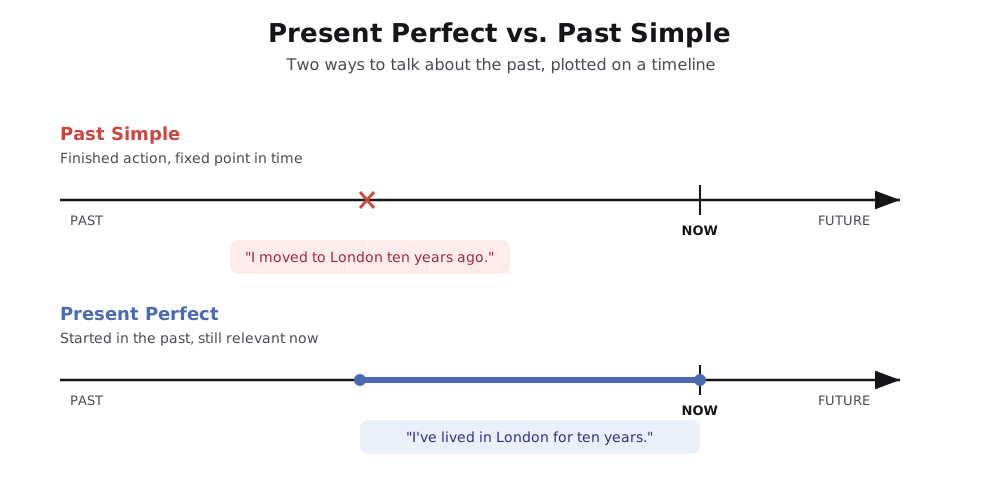
How to Draw It on the Board
Draw a straight line. Mark “NOW” somewhere in the middle-to-right area, since most of what you’re teaching happened before now. For a past simple sentence like “I moved to London ten years ago,” mark a clear X at a fixed point in the past, disconnected from NOW. For a present perfect sentence like “I’ve lived in London for ten years,” draw a line stretching from a past point all the way up to NOW, showing the action is still relevant or still happening. The first time we tried this on the board instead of in a handout, a student who’d been struggling for weeks said the difference finally “clicked,” and that’s stuck with us as the reason we lead with the visual every time now.
Do this with two or three contrasting pairs before you say a single grammar rule out loud. Let students notice the pattern themselves first. It takes a little more class time up front than jumping straight to a worksheet, but it pays that time back many times over in fewer repeated errors later in the course.
Anchor With Time Markers
Once the timeline makes sense visually, time markers become the practical shortcut students can lean on in real conversation. Past simple pairs naturally with yesterday, last week, in 2019, or any specific finished point in time. Present perfect pairs with since, for, ever, never, yet, already, and recently, words that either stretch back from now or deliberately avoid naming a specific time.
Put both lists on the board side by side. Students will start using them as a quick self-check almost immediately, which takes some of the guesswork out of production. We’ve noticed students physically glance up at the board mid-sentence to check themselves against these lists, which is exactly the habit you want to build before you take the lists away.
Check Understanding Before You Move On
Before you send students off to practice, check that the concept actually landed. This is exactly where concept checking questions earn their keep, and it’s a step we’ve learned not to skip, even when a lesson feels like it’s going well. A few quick CCQs here save you from discovering, halfway through a speaking activity, that half the class is still guessing.
Try questions like these:
- “Is the action finished?” (both tenses can be yes, so follow up)
- “Do we know exactly when it happened?”
- “Does it matter right now, in this moment?”
- “Is the person still doing this?”
If students can answer these confidently for both example sentences on your timeline, you’re clear to move into production.
Activities for Teaching Present Perfect vs Past Simple in Class
Understanding a rule and using it under pressure are two different skills. These three activities push students from recognition into actual production, and they’re the ones we come back to most often when we’re planning this lesson ourselves.
Timeline Card Sort
Give pairs a set of sentence cards, half past simple and half present perfect, all mixed up. Students sort them onto a shared timeline drawn on paper or on the board, justifying their placement to their partner. This turns a grammar point into a small negotiation, which keeps students talking through the logic instead of just guessing. We like this one especially for classes that tend to go quiet during grammar practice, since the sorting gives even reluctant talkers something concrete to point at and discuss.
Life Experiences Speaking Activity
Have students interview each other about life experiences using present perfect (“Have you ever…?”), then follow up with past simple to get the details (“When did you go? What was it like?”). This pairing happens constantly in real conversation, so it’s worth drilling the handoff between the two tenses specifically, not just each tense on its own. In our experience, this is often the moment students realize the two tenses aren’t rivals competing for the same sentence, they’re a team, each doing a different job in the same conversation.
Storytelling and Narrative Mixing
Give students a simple prompt, like describing a memorable trip or a big life change, and ask them to open with a present perfect statement before switching into past simple to tell the story. “I’ve traveled to a lot of countries, but Portugal was my favorite” is a natural pattern worth modeling explicitly, since it mirrors how fluent speakers actually move between the two tenses in real time. We usually model this one ourselves first, out loud, with a real story from our own lives, because students tend to relax and open up once they see a teacher get personal instead of just assigning the prompt.
Common Mistakes and How to Correct Them
Using past simple with an unfinished time marker. “I didn’t finished my homework yet” should be “I haven’t finished my homework yet.” Point students back to the time marker list rather than re-explaining the whole rule from scratch.
Adding a specific time to present perfect. “I have seen that movie yesterday” mixes a finished-time marker with a present-relevance tense. This is one of the clearest signals a student hasn’t yet separated the two systems, and it’s worth flagging every time it comes up, gently and without making a big deal of it.
Overusing present perfect once it’s freshly taught. Right after this lesson, some students will overcorrect and use present perfect everywhere, even for clearly finished, dated events. This is a normal stage, not a step backward, and we’ve come to see it as a good sign rather than a setback. It usually means the concept has actually landed and the student is now testing its limits. Ease it out gradually rather than correcting every instance in the moment.