
Adverbs of Frequency Worksheet
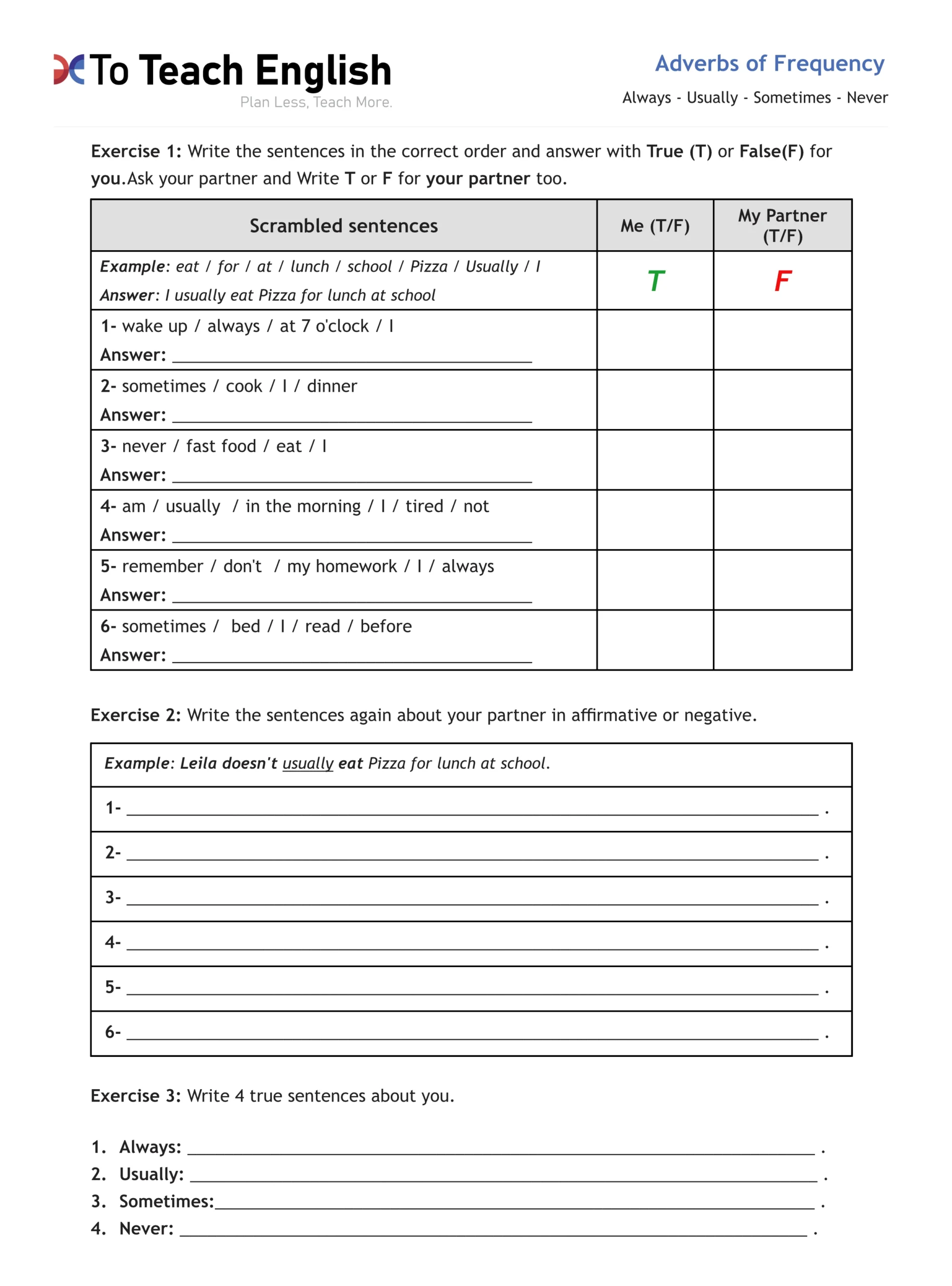
Grammar Worksheet with Answer Key
This free adverbs of frequency worksheet takes A1 students through a full controlled-to-freer practice progression: unscrambling six sentences with always, usually, sometimes, and never in both affirmative and negative forms, personalizing them with a true/false partner-check speaking task, then moving into guided transformation as students rewrite the sentences in the third person about their partner, before finishing with freer, independent writing practice using all four adverbs. The worksheet reinforces subject-verb agreement (don’t/doesn’t, am/is/are) alongside the core position rules for adverbs of frequency, giving teachers a single resource that moves cleanly from controlled practice through personalization to production.
Adverbs of Frequency Quiz Quiz Trade
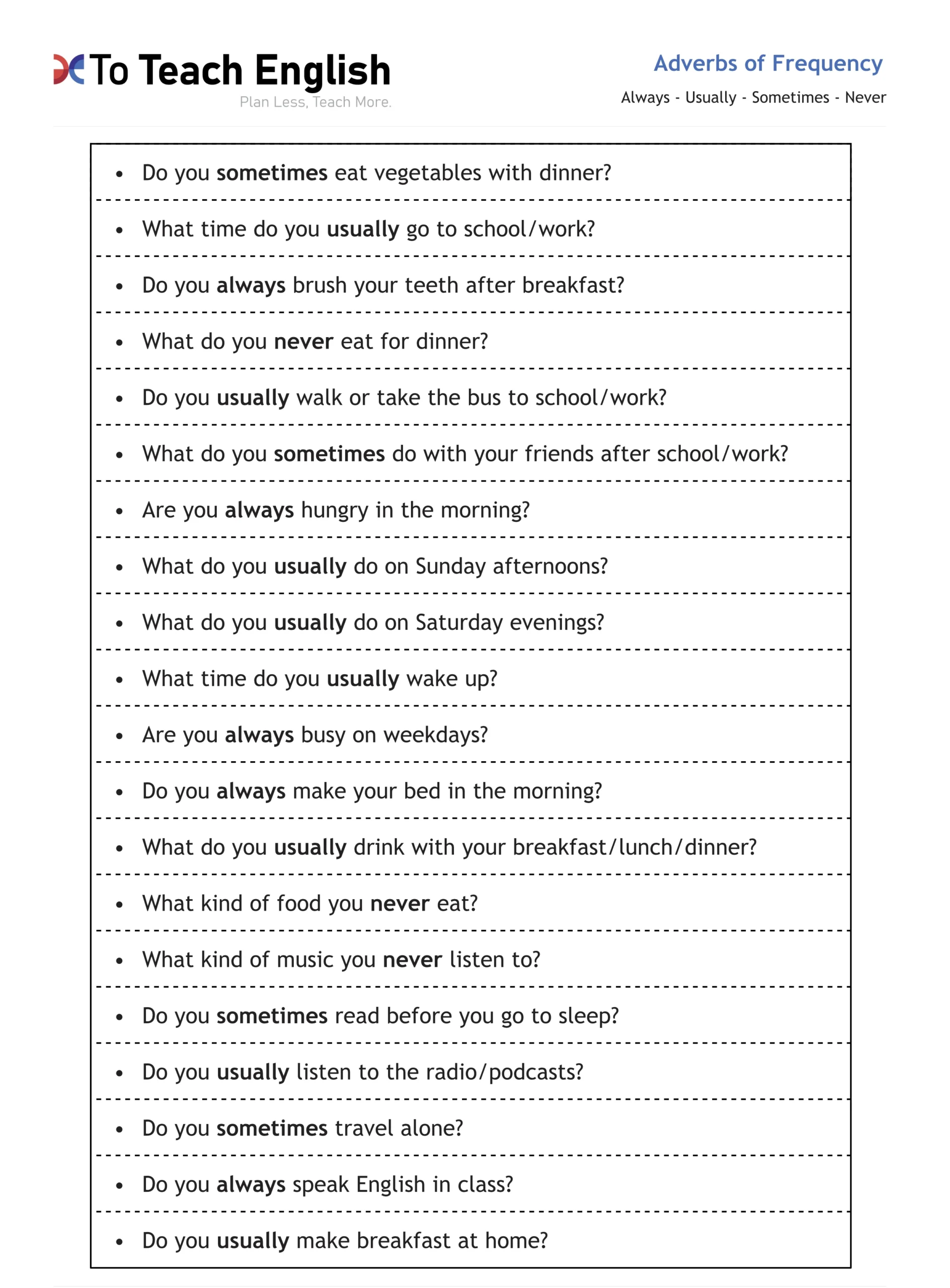
Speaking Activity: Quiz-Quiz-Trade
This speaking activity gets students asking and answering questions with always, usually, sometimes, and never, in a fast-paced mingle or a quieter pair-work version, whichever fits your class. Along the way, students also produce the present simple naturally, since every question and answer runs through it (I usually go to school at 7 o’clock, She always drinks tea in the morning). It’s a simple way to drill two A1 essentials, adverbs of frequency and present simple form, inside one natural, low-prep speaking task.
Adverbs of Frequency Find Someone Who
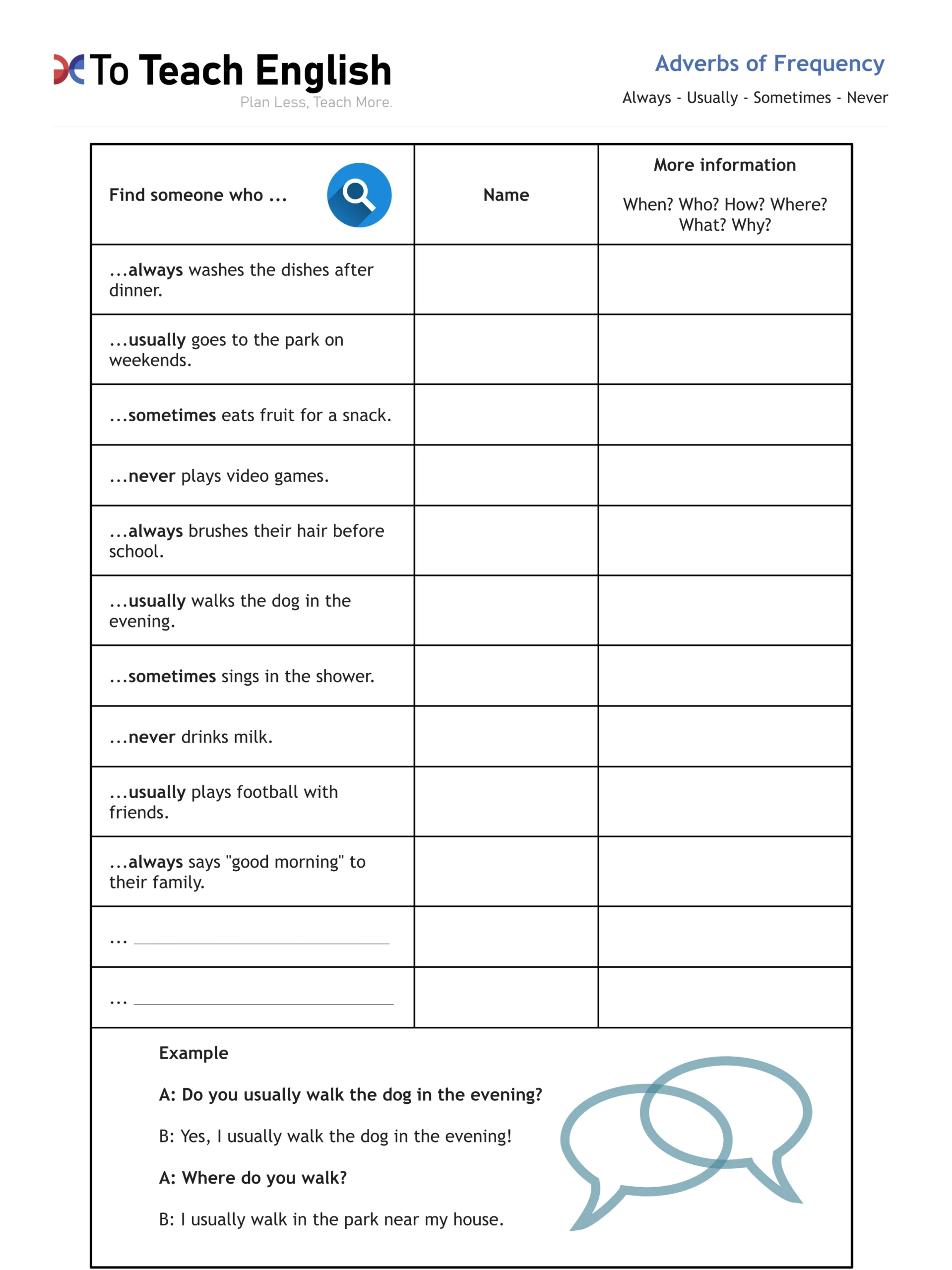
Speaking Activity: Class Mingle
This free Find Someone Who worksheet gets A1 students up, moving, and talking while they practice adverbs of frequency, always, usually, sometimes, and never, through natural “Do you…?” questions. Students mingle around the classroom, ask classmates about daily habits, and extend each answer with a follow-up Wh- question, turning a grammar drill into a real conversation. Two blank rows let students write and ask their own original questions, pushing the activity from guided practice into freer, personalized speaking. It’s a low-prep, high-engagement way to reinforce present simple word order and frequency adverbs together in one class.
Adverbs of Frequency Running Dictation
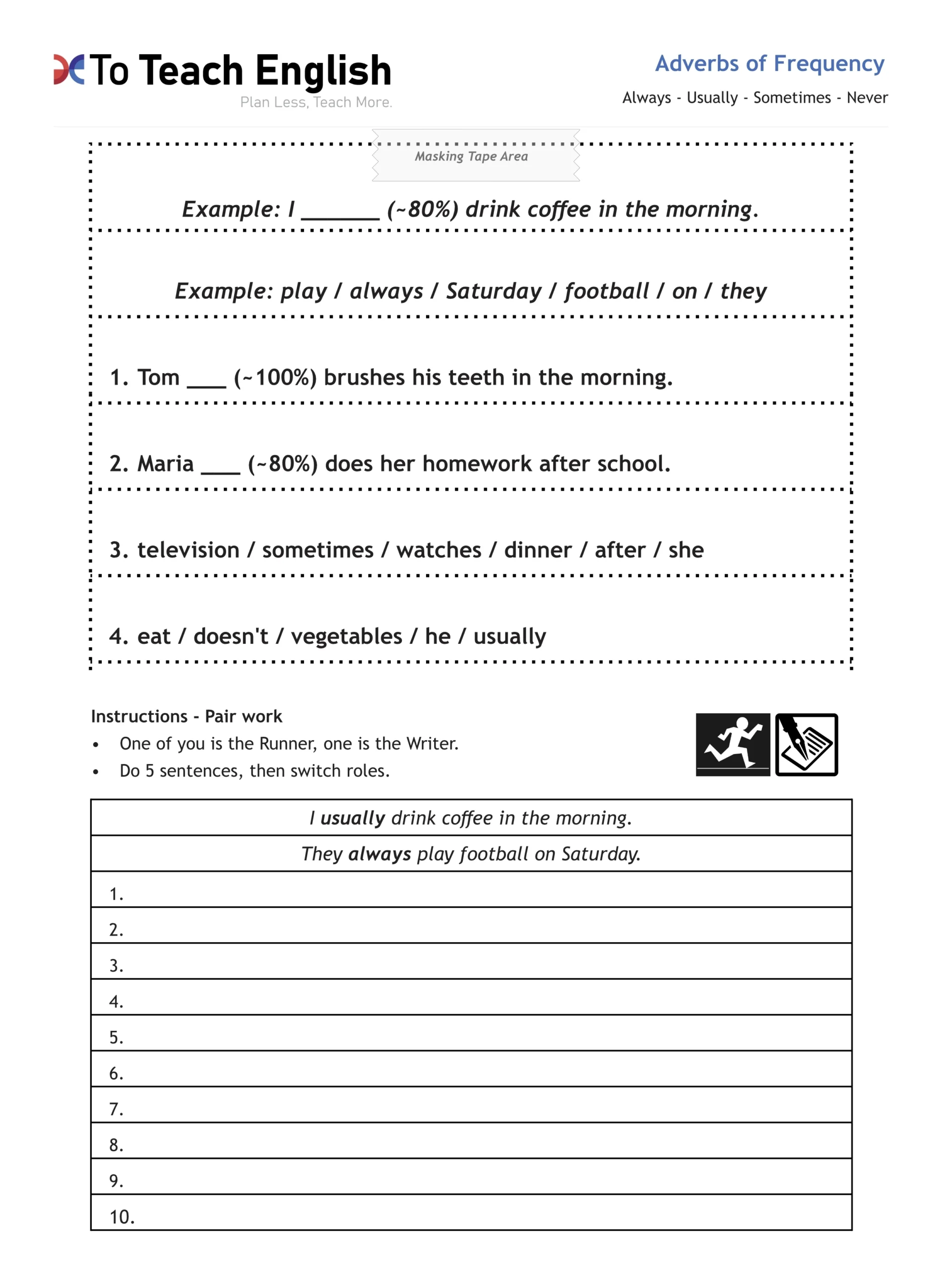
Integrated Skills Activity: Reading, Speaking, Listening, and Writing
This free running dictation worksheet gets A1 students moving, memorizing, and writing as they practice adverbs of frequency, always, usually, sometimes, and never, in the present simple. Students work in pairs as Runner and Writer, taking turns racing to read and memorize sentences posted around the classroom before dictating them back from memory. Four questions test meaning through percentage clues, while six test form, mixing affirmative, negative, and question word order for full grammar reinforcement. Need to split your class into pairs quickly? Try our free Random Team Picker, and keep the activity on track with our Timer.
Adverbs of Frequency Board Game
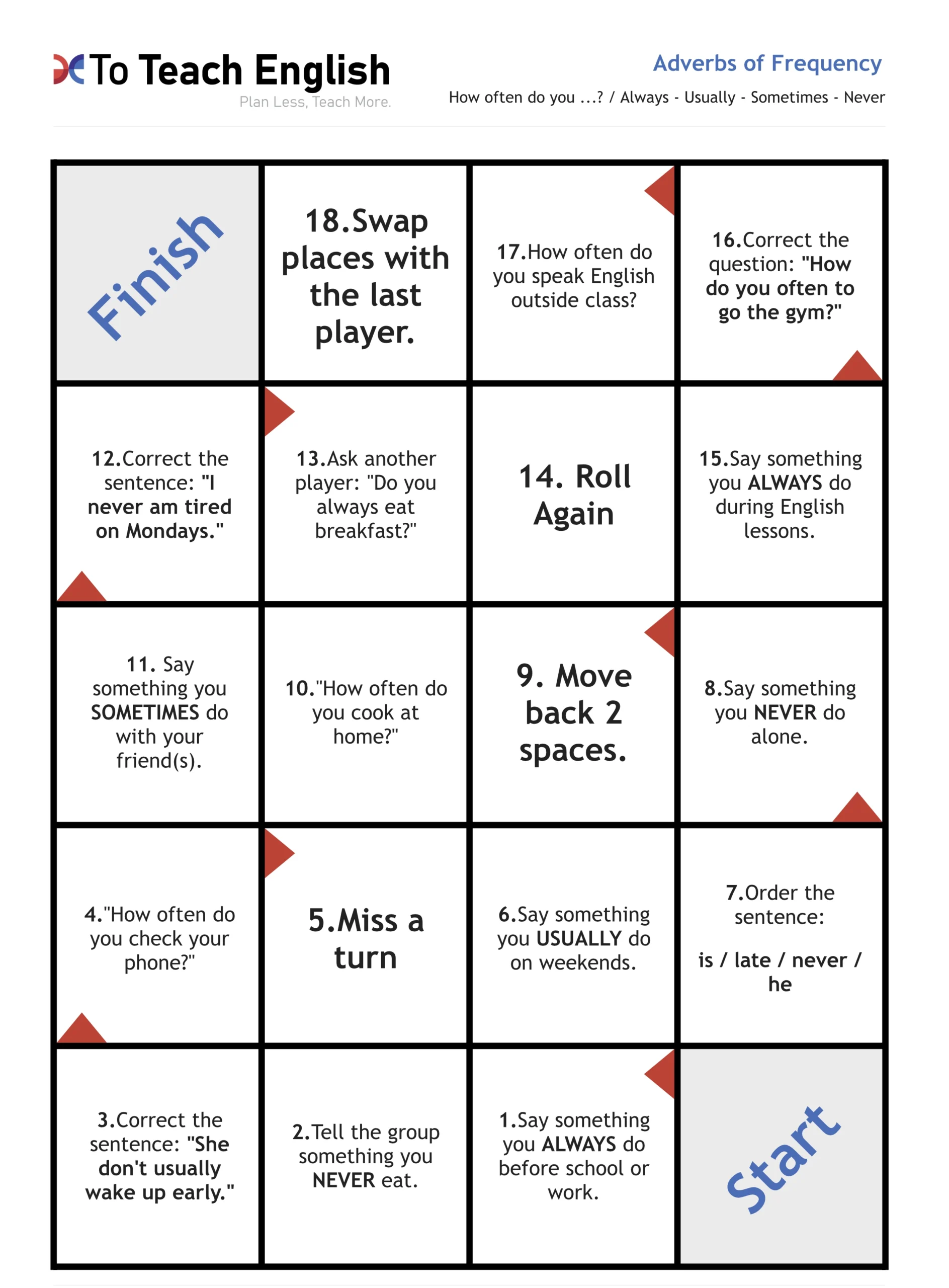
Speaking Game: Groups of Two to Four
This free adverbs of frequency board game gets A1 students speaking and self-correcting in one fast-paced round, mixing freer production of always, usually, sometimes, and never with short “Fix It” squares that reinforce word order and subject-verb agreement (doesn’t/don’t, is/am). Playing in groups of 2–4, students roll, move around a snake-path board, and either produce a sentence, correct one, or follow a quick action square, keeping the target language in constant, natural repetition throughout the game. Need to split your class into groups quickly? Try our free Random Team Picker, and use our Dice Roller if you don’t have a physical die on hand.
Adverbs of Frequency: Exercises with answers
What Are Adverbs of Frequency?
Adverbs of frequency tell us how often something happens. At this level you need four of them.
- always100%every time
- usually~75%most days
- sometimes~35%on some days
- never0%not one time
The four words in a sentence
| Sentence | How often? |
|---|---|
| Marcus always walks to work. | Every day. |
| Rosa usually drinks tea in the morning. | Most mornings. |
| We sometimes eat at a restaurant. | Not often, but yes. |
| Bruno never watches TV. | Not one time. |
They answer one question
All four words answer How often? So the question and the answer go together.
- How often do you cook? I usually cook on the weekend.
- How often does Emma travel? She never travels in winter.
A note on levels. This page teaches four adverbs at A1. There are more of them, like often and hardly ever, and there are phrases like once a week. Those come later, at A2.
Where Do Adverbs of Frequency Go in a Sentence?
There is one rule with two parts. Learn both and you can put these words in any sentence.
Rule 1: before the main verb
Most verbs take the adverb in front of them.
| Subject | Adverb | Verb | Rest |
|---|---|---|---|
| I | always | get up | at seven. |
| Sophie | usually | takes | the bus. |
| My parents | sometimes | visit | my sister. |
| Javier | never | eats | meat. |
Rule 2: after am, is and are
The verb to be is different. Here the adverb goes after it.
| Subject | Be | Adverb | Rest |
|---|---|---|---|
| I | am | always | tired on Monday. |
| The shop | is | usually | open at eight. |
| We | are | sometimes | late. |
| Lucy | is | never | angry. |
The two rules together
| Verb | Where the adverb goes | Example |
|---|---|---|
| walk, eat, work, like | before the verb | He always walks here. |
| am, is, are | after the verb | He is always here. |
A quick check. Look at the verb first. Is it am, is or are? Then the adverb comes after. Is it any other verb? Then the adverb comes before.
Right and wrong
| Wrong | Correct |
|---|---|
| She drinks always coffee. | She always drinks coffee. |
| Always I walk to school. | I always walk to school. |
| He never is late. | He is never late. |
| We sometimes are busy. | We are sometimes busy. |
Adverbs of Frequency in Negative Sentences
You can use usually and sometimes in a negative sentence. They go after don't and doesn't.
| Subject | Negative | Adverb | Verb |
|---|---|---|---|
| I | don't | usually | work on Friday. |
| We | don't | sometimes | agree. |
| Oliver | doesn't | usually | answer the phone. |
Careful with the verb. After doesn't the verb has no -s. This is the present simple rule and it does not change. See Present Simple for more on this.
Never is already negative
The word never means not one time. So the sentence is negative. Do not add don't or doesn't.
| Wrong | Correct |
|---|---|
| I don't never drink coffee. | I never drink coffee. |
| Isabel doesn't never call me. | Isabel never calls me. |
| They aren't never at home. | They are never at home. |
Two ways to say the same thing
These two sentences mean the same. Both are correct.
- Daniel never eats breakfast.
- Daniel doesn't eat breakfast.
The first one is stronger, because never says not one time.
Always is different
We do not say don't always at this level. If you mean 0%, use never.
| You mean | Say this |
|---|---|
| 0% | I never take the bus. |
| not most days | I don't usually take the bus. |
Questions with How Often
To ask about frequency, start the question with How often.
Word order
| How often | Do / Does | Subject | Verb |
|---|---|---|---|
| How often | do | you | go to the gym? |
| How often | do | they | call you? |
| How often | does | Sofia | work late? |
| How often | does | the bus | stop here? |
The verb after does has no -s.
The adverb is not in the question
Put the adverb in the answer, not in the question.
| Wrong | Correct |
|---|---|
| How often do you always cook? | How often do you cook? |
| How often you go to the movies? | How often do you go to the movies? |
| How often does Henry plays soccer? | How often does Henry play soccer? |
Answering
Use a full sentence. The adverb goes in its normal place.
| Question | Answer |
|---|---|
| How often do you cook? | I usually cook in the evening. |
| How often does Grace travel? | She sometimes travels for work. |
| How often do they eat fish? | They never eat fish. |
Asking with be
With am, is and are, there is no do or does.
- How often are you late? I am never late.
- How often is the shop closed? It is sometimes closed on Sunday.
Common Mistakes with Adverbs of Frequency
Four mistakes cause most of the errors with these words. Check your writing for these four.
Mistake 1: putting the adverb after the verb
The adverb comes before the main verb, not after it.
| Wrong | Correct |
|---|---|
| Clara eats always fruit. | Clara always eats fruit. |
| I go sometimes to the market. | I sometimes go to the market. |
Mistake 2: putting the adverb before am, is or are
With to be the adverb comes after.
| Wrong | Correct |
|---|---|
| He always is happy. | He is always happy. |
| They never are at home. | They are never at home. |
Mistake 3: don't with never
Never is already negative. One negative is enough.
| Wrong | Correct |
|---|---|
| Marta doesn't never help. | Marta never helps. |
| We don't never go there. | We never go there. |
Mistake 4: forgetting the -s
The adverb does not change the verb. After he, she and it, the verb still takes an -s.
| Wrong | Correct |
|---|---|
| Hugo always walk to work. | Hugo always walks to work. |
| She sometimes study at night. | She sometimes studies at night. |
A quick check before you finish
- Is the verb am, is or are? Then the adverb comes after it.
- Is it any other verb? Then the adverb comes before it.
- Is the word never there? Then take out don't and doesn't.
- Is the subject he, she or it? Then check the verb for the -s.
One page that goes with this one. These four words sit inside the present simple, so the -s rule and the don't and doesn't rules come from there. See Present Simple.