
Present Simple Worksheet: Meaning and Form
Grammar Worksheet with Answer Key
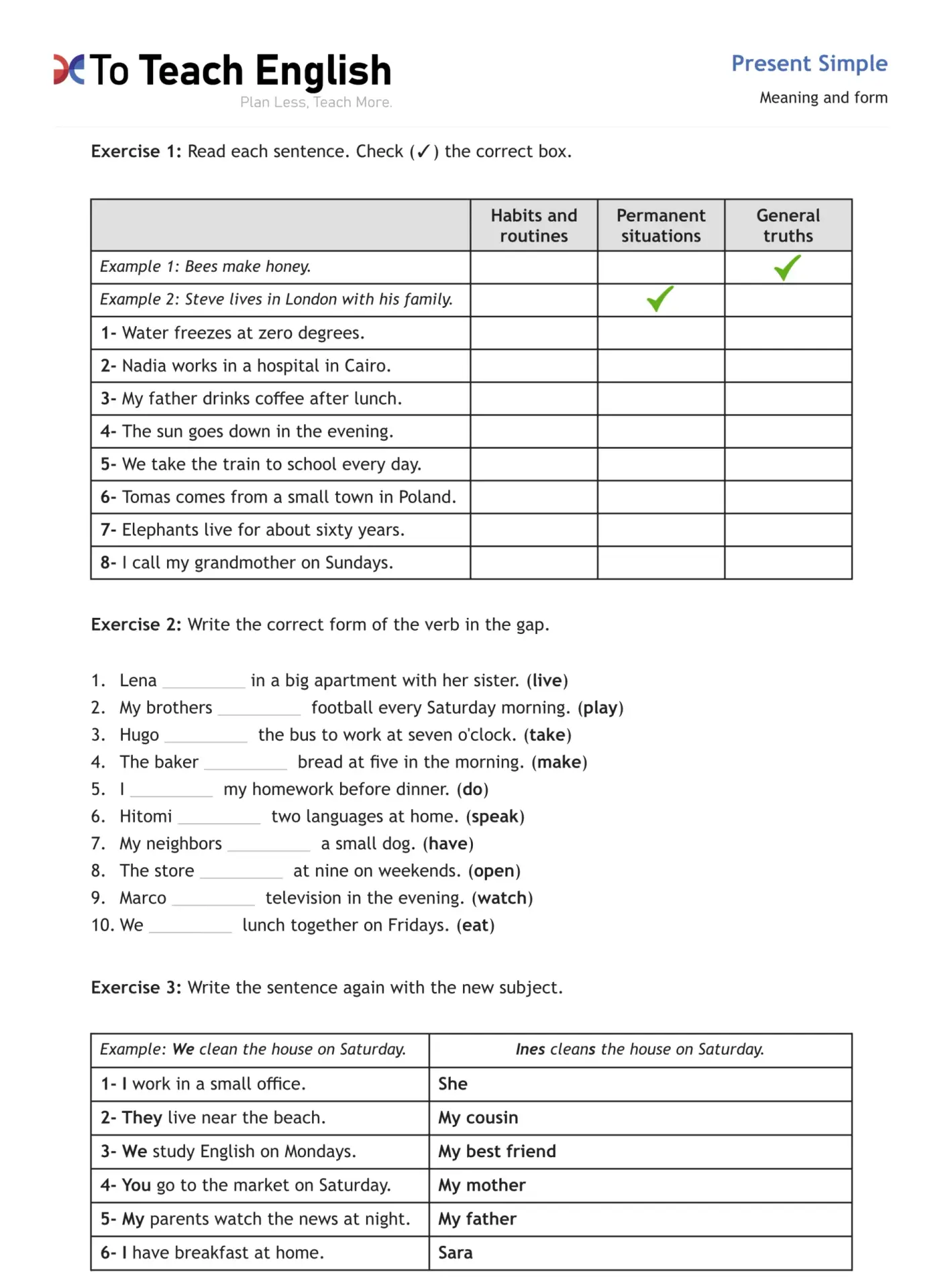
Five exercises across two student pages, moving from recognizing meaning to writing sentences.
Exercise 1 is the one most worksheets skip. Students read eight sentences and decide whether each is a habit, a permanent situation, or a general truth. Meaning comes before form, so students meet the third person -s already knowing what the tense does, rather than treating it as spelling.
Exercises 2 and 3 handle the form. First a gap-fill with the verb in brackets, then a transformation task where the subject changes and students have to supply the -s themselves instead of choosing it from a list.
Exercises 4 and 5 sit on their own page, so you can set them as homework. Exercise 4 returns to the three uses from Exercise 1, and Exercise 5 asks for a short paragraph using and, but, and because, which are the A1 connecting words.
The teacher page carries the procedure, timing, aim, and the full answer key for exercises 1 to 3. Free PDF, no account required.
Present Simple Worksheet: Error Correction
Grammar Worksheet with Answer Key
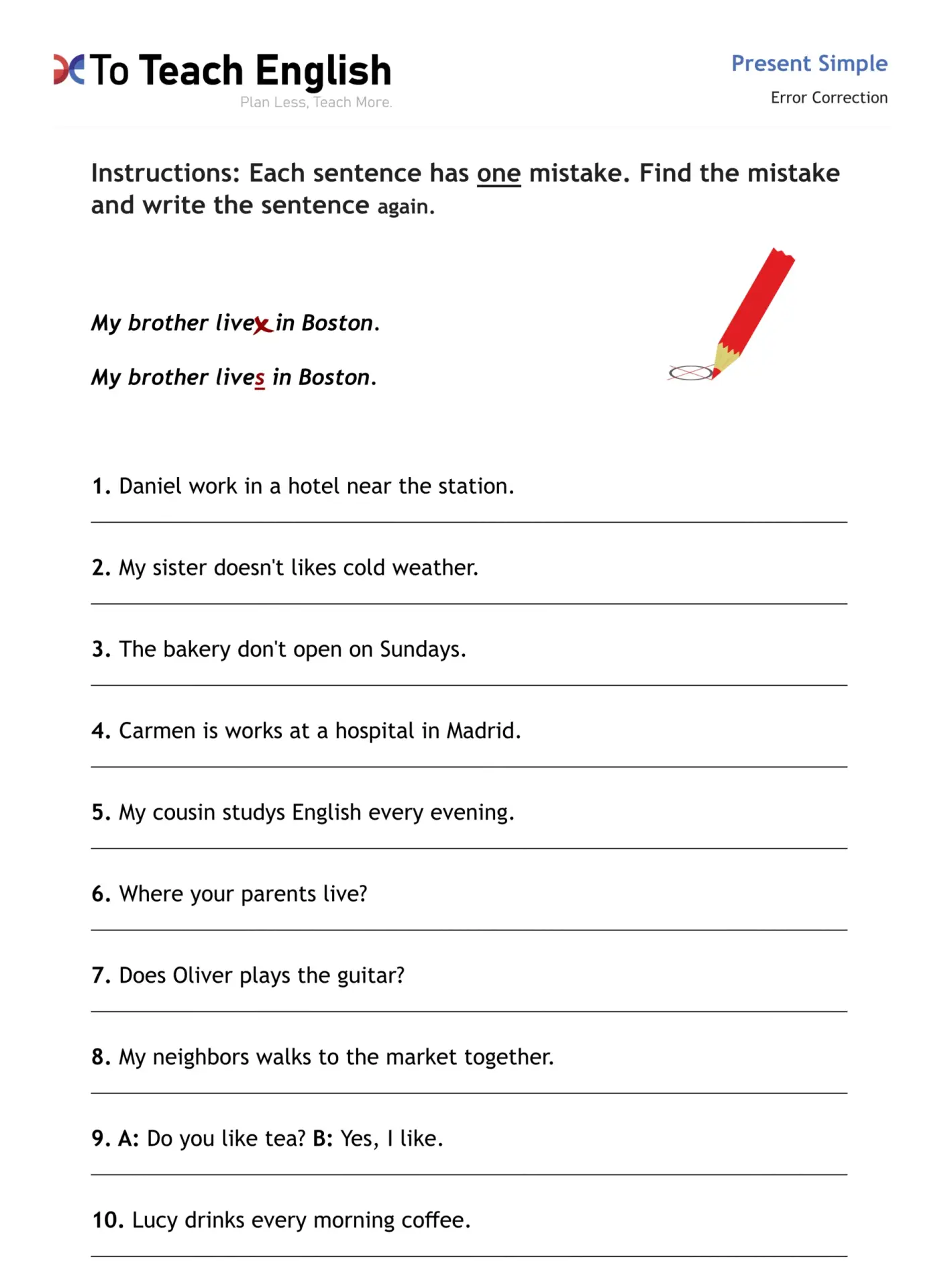
Ten sentences, one mistake in each, with a worked example at the top and a ruled line under every item.
Every sentence targets a different error. The missing third person -s, the extra -s after doesn’t and does, don’t used with he or she, a spelling slip on studies, a question missing its do, an -s added to a plural subject, a wrong short answer, and a time expression in the wrong place.
Two items are worth the class time. Item 4 hides an extra is before the main verb, which students often hear as correct. Item 8 is the reverse of item 1, so anyone who has just learned the -s rule will be tempted to add it where it does not belong.
The teacher page carries the procedure, timing, aim, the full answer key, and notes on the three items that cause the most trouble. Free PDF, no account required.
Present Simple Spelling and Word Order Worksheet
Grammar Worksheet with Answer Key
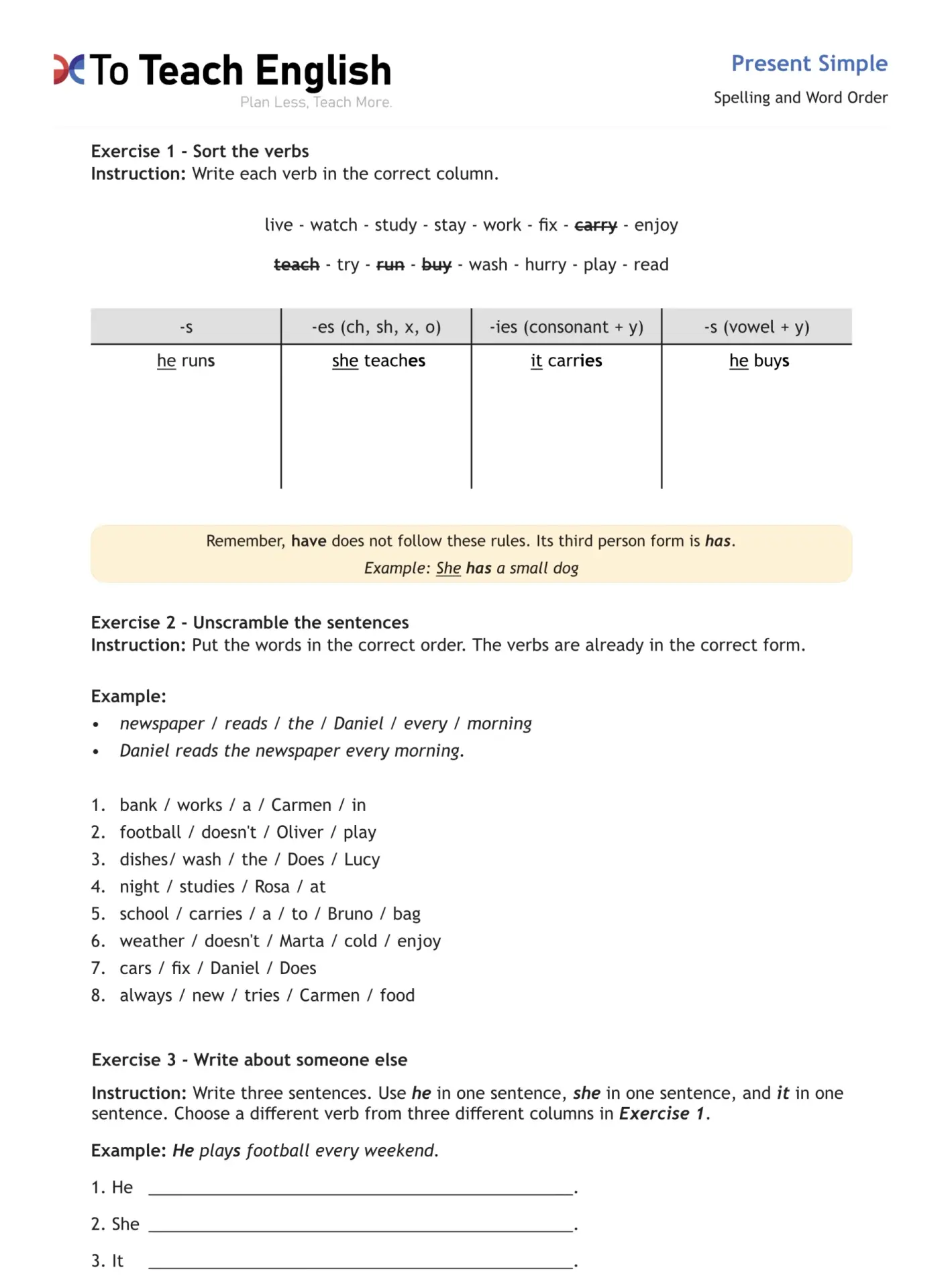
Sixteen verbs, four spelling rules, and one worksheet that keeps spelling and word order as two separate skills instead of testing both at once.
Exercise 1 has students sort sixteen verbs into four columns, each one built on a different third person spelling rule. Every column starts with a worked example using he, she, or it, so the sorting task stays tied to the grammar it’s testing rather than becoming a pattern-matching exercise. A short note reminds students that have doesn’t follow any of the four rules.
Exercise 2 takes the same verbs, already correctly spelled, and scrambles the sentence around them. With spelling out of the way, students focus entirely on word order, including two questions where Does has to move to the front.
Exercise 3 asks students to write their own sentences with he, she, and it, choosing a different verb from a different column each time. A quick peer check afterward has students confirm each other’s verb endings match the column they came from.
The teacher page has the procedure, timing, aim, and the full answer key for Exercises 1 and 2. Exercise 3 is open, with a note on what to check. Free PDF, no account required.
Present Simple Running Dictation
Integrated Skills Activity: Reading, Speaking, Listening, and Writing
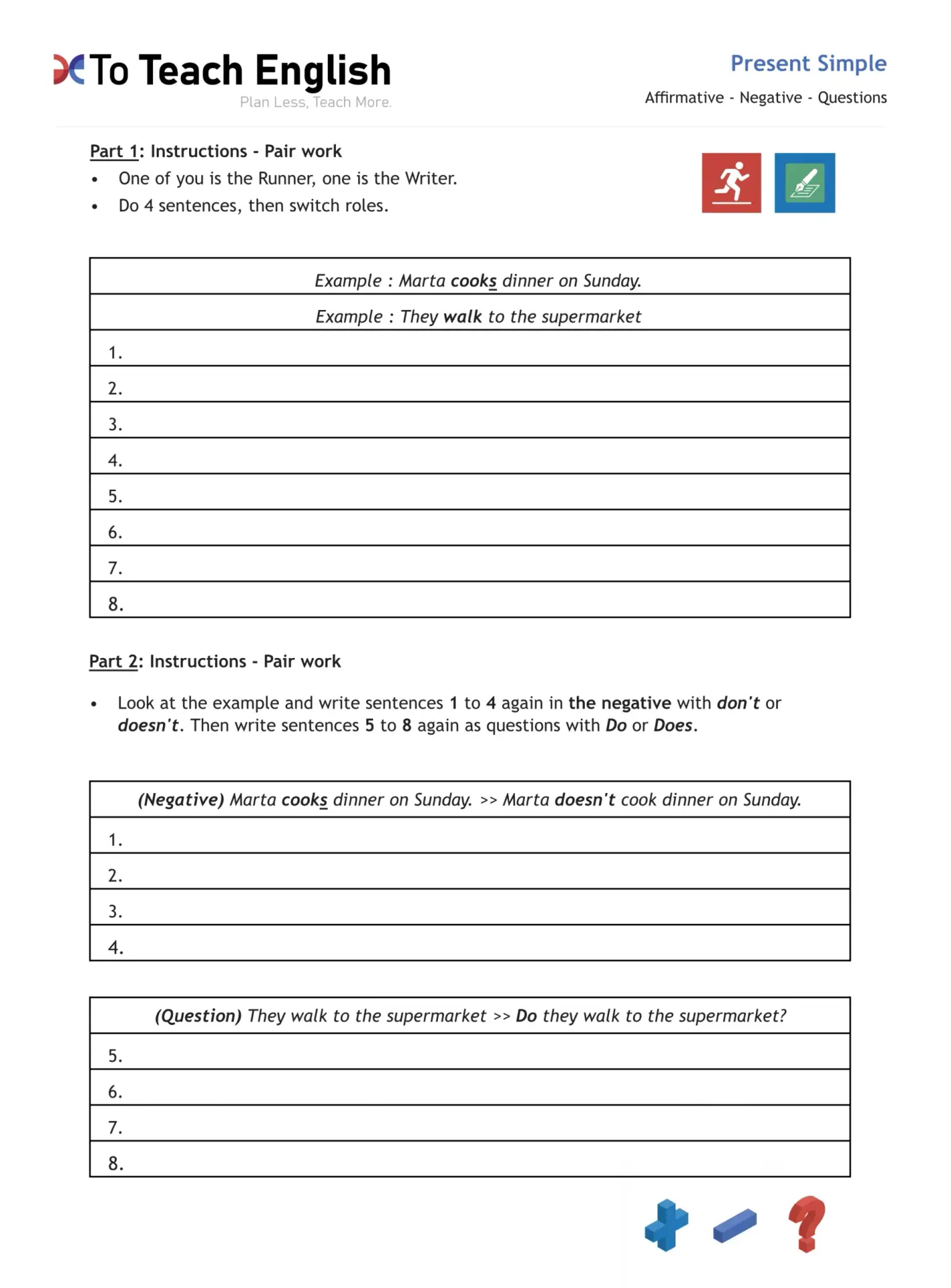
Eight gapped sentences to cut out and tape on the wall. One student runs and reads, the other writes, and they swap after four sentences.
The runner has to put the verb in the correct form before carrying the sentence back, so the spelling of the third person happens at the wall, under pressure, rather than in a quiet gap-fill. All four spelling patterns appear across the eight sentences, including washes, studies, carries, and the irregular has.
Answer key included, with all three stages keyed. Free PDF, no account required.
Present Simple Quiz-Quiz-Trade
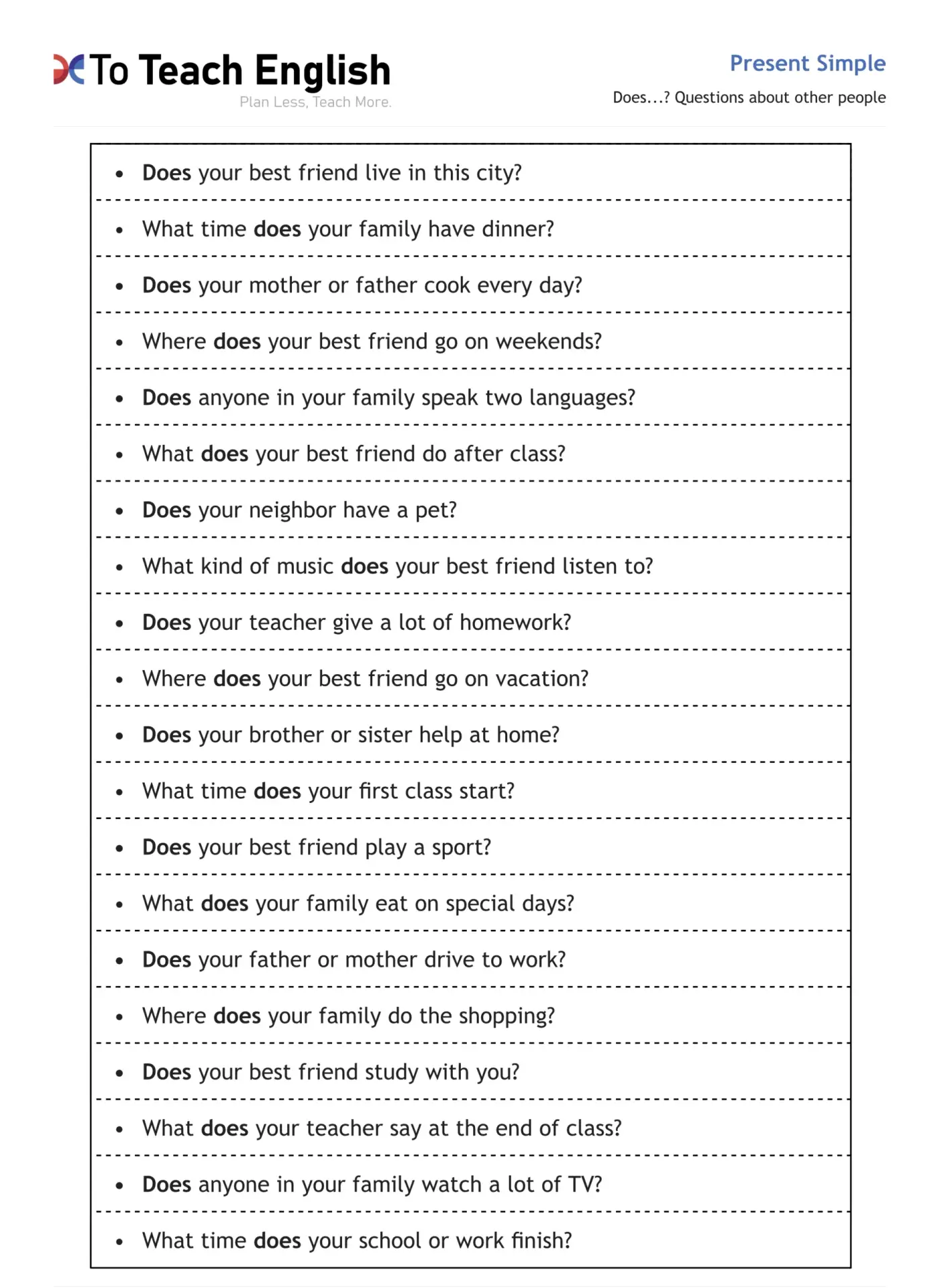
Speaking Activity: Quiz-Quiz-Trade
Twenty question strips, cut and handed out one per student. Students quiz a partner, answer, then trade strips and find someone new.
Every question asks about somebody else, so the answer has to carry the third person -s. That is the form students drop most often, and it is the one they almost never practice out loud.
Ten strips start with Does, ten with a question word. Because students trade after every exchange, each one meets both patterns within a few minutes.
Works as a whole-class mingle or as a quieter pair activity with the full set face-down between two students. The teacher page has both versions. Free PDF, no account required.
Present Simple Find Someone Who
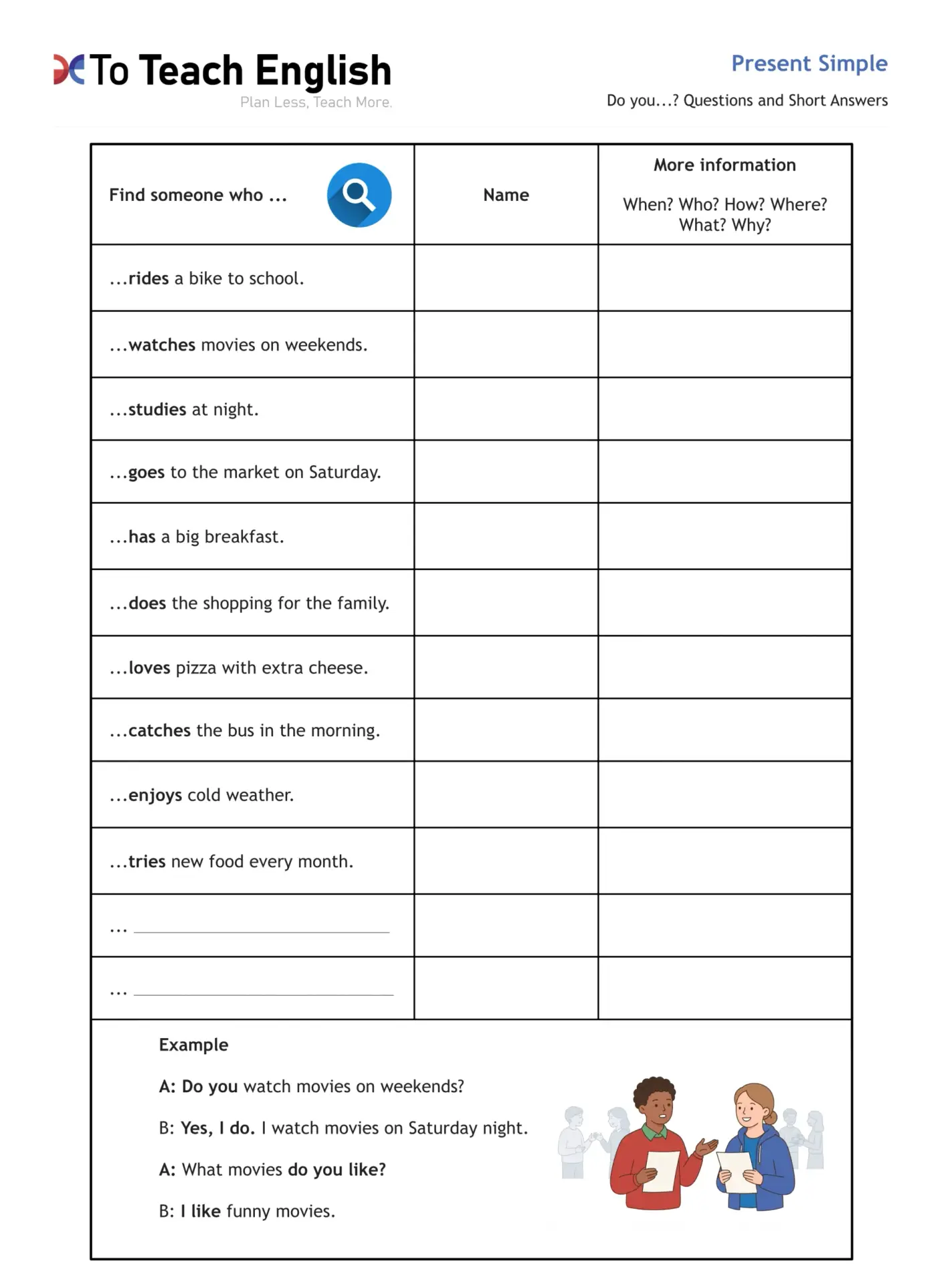
Speaking Activity: Class Mingle
Ten statements about daily life, plus two blank rows students fill in themselves. Students turn each statement into a Do you…? question, then move around the room to find a classmate who says yes.
The transformation is the point. Every statement on the sheet carries the third person -s, and every question drops it. Students meet that switch ten times in twenty minutes, which is far more repetition than a worksheet gives them.
A third column asks for follow-up information, so the activity does not stop at yes or no. Students ask When?, Where? or Why? and write down the answer, which gives you a natural reporting stage at the end.
The two blank rows are where the writing happens. Students invent their own statements about a classmate, so they have to produce the -s themselves rather than read it.
The teacher page carries the procedure, level, timing, aim and a target language example. No answer key, since the answers are the students’ own. Free PDF, no account required.
Present Simple Board Race
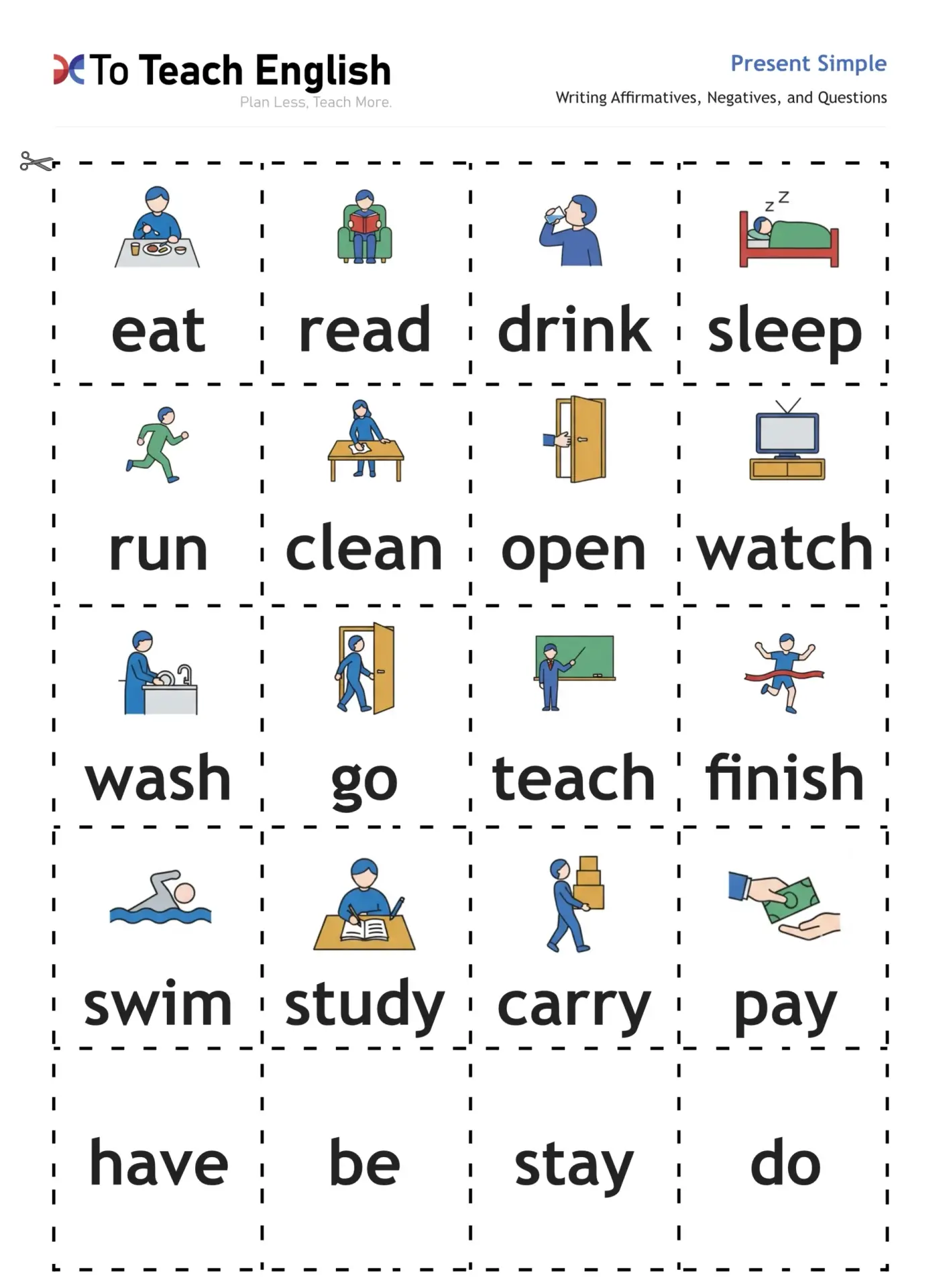
Team Game: Sentence Board Race
Twenty verb cards to cut out and hide in a corner of the room. or outside the classroom. Teams of three or four send a writer to fetch one card, then build a sentence together before the writer takes it to the board.
The group does the grammar out loud and the writer only transcribes, so three or four students produce every sentence instead of one.
You call the form each round, which is what keeps the target language moving. Affirmative first, then affirmative with he, she, or a name so the third person -s appears, then negatives with don’t and doesn’t, then questions with Do and Does.
Two card sets are included. Page 2 pairs each verb with a picture for younger or lower-level classes. Page 3 has the same twenty verbs as words only, for a stronger challenge. Four cards carry no picture at all, including be, which reliably produces the She is play football error you want for the feedback stage.
Feedback comes at the end, not mid-game. Free PDF, no account required.
Present Simple Discussion Questions
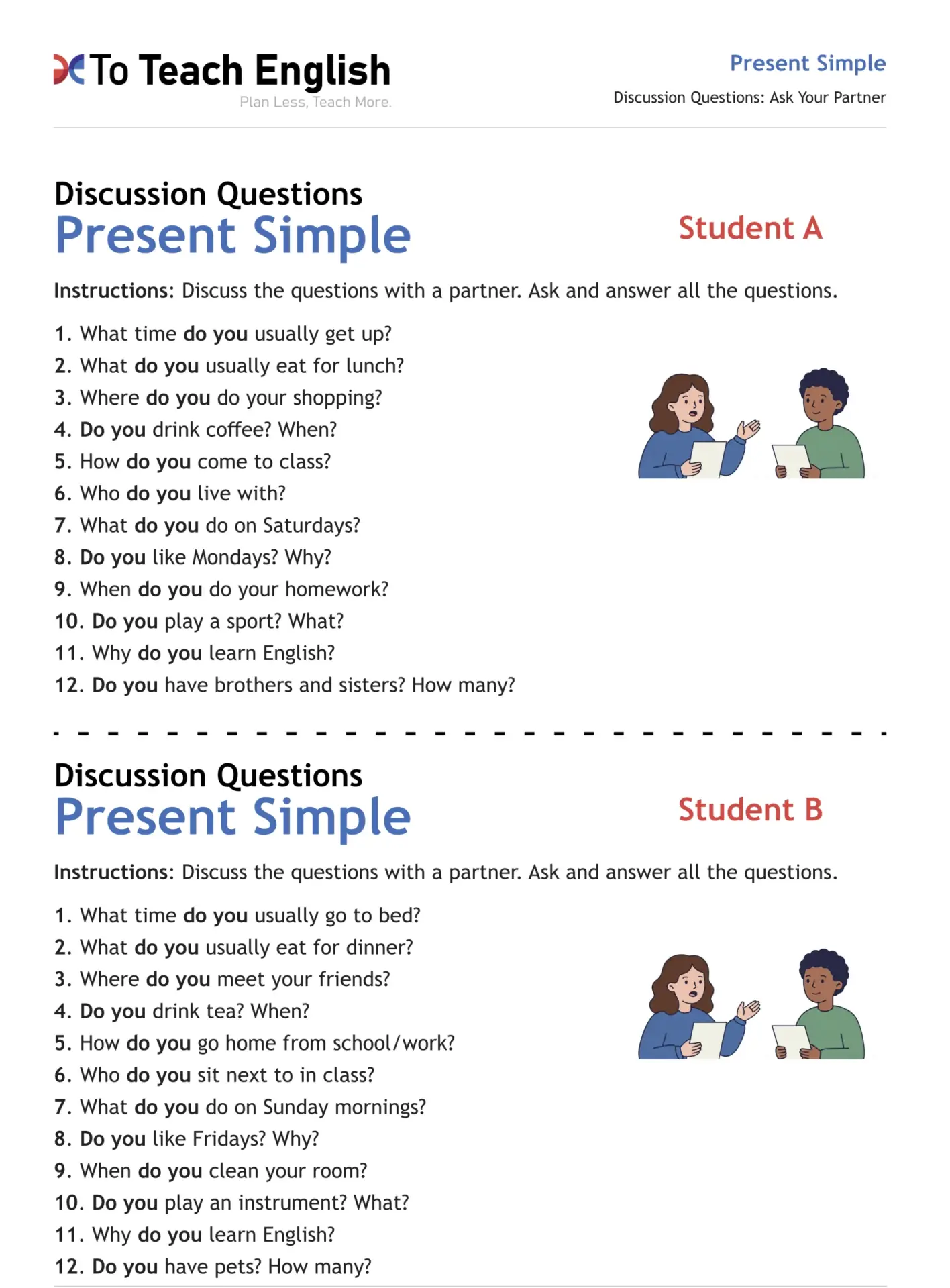
Speaking Activity: Student A/B
Twelve questions for Student A and twelve for Student B, cut along the dashed line. Students ask and answer in turn, then swap sheets and run the set again with a new partner.
The questions cover all six A1 question words, plus what time and how many. Four items are yes/no questions with a short follow-up, so students practise both patterns in one activity.
The teacher page carries the procedure, level, timing and aim. No answer key, since the answers are the students’ own. Free PDF, no account required.
Present Simple Board Game
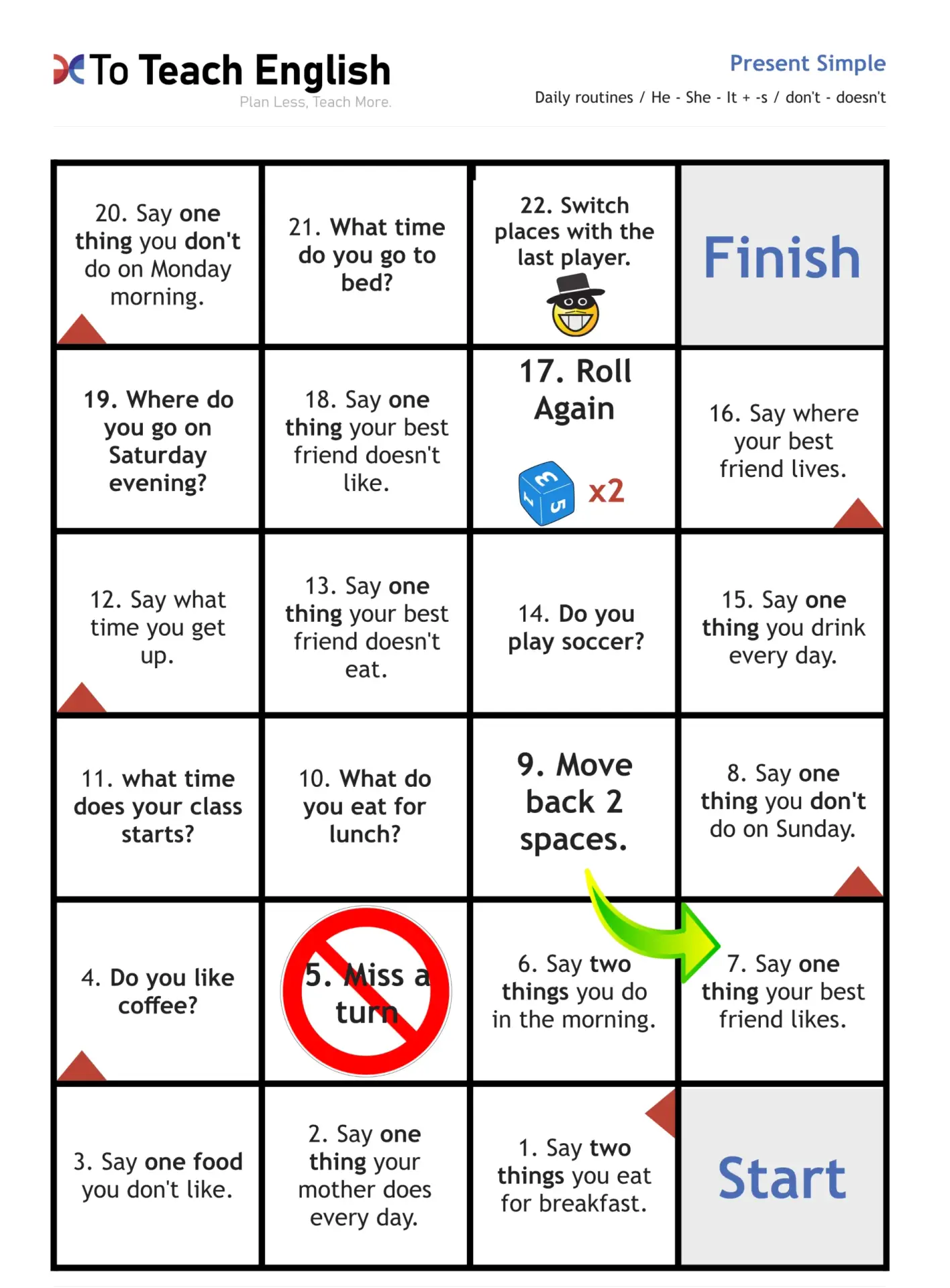
Speaking Game: Groups of Two to Four
Twenty-two squares, played with one die and a counter each, in groups of two to four.
Every square asks for language out loud. Most ask for a statement, which is where this game differs from the rest of the page. Four squares need don’t or doesn’t, and four ask about somebody else, so the third person –s has to appear.
Six squares print a question. The player reads it and answers it, which gives short answers somewhere to live. Yes, I do is the target, not Yes, I like coffee.
Four action squares break up the talking. One sends a player back two spaces and one switches them with whoever is last, so a student who falls behind stays in the game.
Bring your own counters. Coins, erasers or paper clips all work, and there is nothing to cut out beforehand.
The teacher page carries the procedure, level, timing and aim. No answer key, since the answers are the students’ own. Free PDF, no account required.
Present Simple Exercises with Answers (A1)
When Do We Use the Present Simple?
We use the present simple for three things. Look at each one below.
1. Habits and routines
These are things people do again and again.
- Grace starts work at nine o'clock.
- Marcus and Diego play soccer on Fridays.
- I check my phone every morning.
2. Permanent situations
These are things that stay the same for a long time.
- Charlotte lives in Oslo.
- Henry works in a shoe shop.
- My grandparents have a small garden.
3. General truths
These are facts. They are true for everybody.
- Bananas grow in hot countries.
- Bees make honey.
- People speak Spanish in Mexico.
The three uses together
| Example | Use |
|---|---|
| Clara drinks tea in the evening. | Habit |
| Thomas comes from Dublin. | Permanent situation |
| Cars need gas. | General truth |
A note on levels. This page teaches the present simple at A1. At A2 the tense does more work. It also talks about timetables, for example the time a train leaves. Our Present Simple A2 page covers that.
Present Simple Form: Positive Sentences
The positive form is easy. We use the verb with no changes, but he, she and it take an -s.
The verb "work" with every subject
| Subject | Verb | Example |
|---|---|---|
| I | work | I work in a hotel. |
| You | work | You work very hard. |
| He | works | He works in a bakery. |
| She | works | She works with children. |
| It | works | The elevator works again. |
| We | work | We work on Saturdays. |
| They | work | They work in the same office. |
Word order in positive sentences
Put the subject first, then the verb, then the rest of the sentence.
| Subject | Verb | Rest |
|---|---|---|
| Ines | studies | Italian in college. |
| My neighbors | keep | two cats. |
| Carlos | sells | fruit in the market. |
Names and nouns follow the same rule
A name works like he, she or it. So the verb takes an -s.
- Rosa cooks dinner for her family.
- My brother wants a new bike.
- The shop opens at eight.
But a plural noun works like they. So there is no -s.
- My parents live near the beach.
- The shops close late on Friday.
One important exception. The verb to be does not follow this pattern. It has three different forms: am, is and are. See our page on the present simple of "to be" for that.
Third Person -s Spelling Rules: -s, -es and -ies
After he, she and it, most verbs add -s. But some verbs change first. There are four rules.
Rule 1: most verbs add -s
| Verb | He / She / It |
|---|---|
| read | reads |
| help | helps |
| swim | swims |
| write | writes |
Rule 2: after -ch, -sh, -ss, -x and -o, add -es
| Verb | He / She / It |
|---|---|
| teach | teaches |
| finish | finishes |
| pass | passes |
| mix | mixes |
| go | goes |
Rule 3: consonant + y becomes -ies
Look at the letter before the y. If it is a consonant, change the y to -ies.
| Verb | He / She / It |
|---|---|
| carry | carries |
| try | tries |
| hurry | hurries |
Rule 4: vowel + y takes only -s
If the letter before the y is a, e, i, o or u, do not change the y.
| Verb | He / She / It |
|---|---|
| enjoy | enjoys |
| buy | buys |
| stay | stays |
Two verbs to learn
These two do not follow the rules above. Learn them now.
| Verb | He / She / It | Example |
|---|---|---|
| have | has | Pablo has a big family. |
| do | does | Emma does the shopping on Friday. |
Present Simple Negative: Don't and Doesn't
To make a negative sentence, we add don't or doesn't before the verb.
Which one do I use?
| Subject | Negative | Example |
|---|---|---|
| I | don't | I don't eat meat. |
| You | don't | You don't need a ticket. |
| He | doesn't | He doesn't drive. |
| She | doesn't | She doesn't wear a uniform. |
| It | doesn't | It doesn't cost much. |
| We | don't | We don't open on Sunday. |
| They | don't | They don't know my address. |
The most important rule
After doesn't, the verb never takes an -s. The word doesn't already carries it.
| Wrong | Correct |
|---|---|
| Rosa doesn't works on Mondays. | Rosa doesn't work on Mondays. |
| The bus doesn't stops here. | The bus doesn't stop here. |
| Miguel don't like fish. | Miguel doesn't like fish. |
Full forms and short forms
We use the short form when we speak and in friendly writing. The full form is more formal.
| Full form | Short form |
|---|---|
| do not | don't |
| does not | doesn't |
- Megan does not answer the phone at work.
- Megan doesn't answer the phone at work.
Present Simple Questions and Short Answers
These questions ask for yes or no. We start them with Do or Does.
Word order in questions
| Do / Does | Subject | Verb | Rest |
|---|---|---|---|
| Do | you | live | near the station? |
| Do | they | sell | bread here? |
| Does | Bruno | work | at the airport? |
| Does | your sister | drive | to college? |
The verb after Does has no -s. This is the same rule as the negative.
| Wrong | Correct |
|---|---|
| Does Sophie wants a coffee? | Does Sophie want a coffee? |
| Do Marta lives in Vienna? | Does Marta live in Vienna? |
Short answers
We do not repeat the main verb. We use do, does, don't or doesn't.
| Question | Yes | No |
|---|---|---|
| Do you like tea? | Yes, I do. | No, I don't. |
| Do they play chess? | Yes, they do. | No, they don't. |
| Does Javier cook? | Yes, he does. | No, he doesn't. |
| Does the train stop here? | Yes, it does. | No, it doesn't. |
Careful. Say Yes, I do and not Yes, I like. The short answer uses only the little word.
Present Simple Wh-Questions
A yes/no question asks for yes or no. A wh-question asks for information.
The question words
| Word | It asks about | Example |
|---|---|---|
| What | a thing | What do you eat for breakfast? |
| Where | a place | Where does Lucy live? |
| When | a time | When does the market open? |
| Who | a person | Who do you sit with in class? |
| Why | a reason | Why do they walk to school? |
| How | a way | How do you travel to work? |
Word order in wh-questions
Put the question word first. Then use the same order as a yes/no question.
| Wh-word | Do / Does | Subject | Verb |
|---|---|---|---|
| Where | do | your friends | meet? |
| What | does | Oliver | study? |
| When | do | we | pay? |
| How | does | Isabel | get home? |
Answers are full sentences
A short answer does not work here, because the question asks for information.
- Where does Hugo work? He works in a museum.
- Why do you take the bus? I take the bus because it is cheap.
- What do your parents drink in the morning? They drink coffee.
| Wrong | Correct |
|---|---|
| Where Isabel lives? | Where does Isabel live? |
| What does Oliver studies? | What does Oliver study? |
Time Expressions with the Present Simple
Time expressions tell us how often or when something happens. They work well with the present simple.
Common time expressions at A1
| Group | Examples |
|---|---|
| every ... | every day, every morning, every week, every summer |
| on ... | on Monday, on Fridays, on my birthday, on the weekend |
| in ... | in the morning, in the afternoon, in the evening |
| at ... | at night, at six o'clock |
Where they go in the sentence
Most time expressions go at the end. This is the safe position.
- Daniel visits his grandmother every Sunday.
- We have a class in the afternoon.
- The bakery opens at seven o'clock.
You can also put them at the start. Then use a comma.
- Every Sunday, Daniel visits his grandmother.
- In the afternoon, we have a class.
One position to avoid
Do not put the time expression between the verb and the object.
| Wrong | Correct |
|---|---|
| Sofia drinks every morning tea. | Sofia drinks tea every morning. |
| They clean on Saturday the house. | They clean the house on Saturday. |
Two pages that go with this one. Words like always and never sit in a different place in the sentence. See Adverbs of Frequency for that. For more on in, on and at, see Prepositions of Time. Phrases such as once a week come later, at A2.
Common Mistakes with the Present Simple
Four mistakes cause most present simple errors. Check your writing for these four.
Mistake 1: keeping the -s after doesn't
The word doesn't already shows he, she or it. So the main verb stays plain.
| Wrong | Correct |
|---|---|
| She doesn't likes the movie. | She doesn't like the movie. |
| It doesn't rains here in July. | It doesn't rain here in July. |
Mistake 2: using don't with he, she or it
| Wrong | Correct |
|---|---|
| My uncle don't smoke. | My uncle doesn't smoke. |
| The elevator don't work today. | The elevator doesn't work today. |
Mistake 3: forgetting the -s
This is the most common mistake of all, because the sound is small.
| Wrong | Correct |
|---|---|
| Henry play the guitar. | Henry plays the guitar. |
| My cousin study in Berlin. | My cousin studies in Berlin. |
Mistake 4: adding is, am or are
A present simple verb does not need is, am or are in front of it. Use one verb only.
| Wrong | Correct |
|---|---|
| Clara is works in a bank. | Clara works in a bank. |
| I am like chocolate. | I like chocolate. |
A quick check before you finish
- Is the subject he, she or it? Then check for the -s.
- Is there a don't, doesn't, do or does? Then the main verb has no -s.
- Is there a second verb like is or are? Then take it out.